Writing
Human Clinicians Still Outperform AI in Couples and Group Therapy. But How Long Will That Last?
Artificial intelligence may, in certain respects, function as a more consistent clinician than a human. It can simulate unconditional positive regard. It can validate a client’s experience. It can respond without fatigue. It doesn’t have an off day. It doesn’t carry personal stress into the room. It can provide structured interaction at scale, twenty-four hours a day. Studies examining AI-driven mental health chatbots have found that users often perceive these systems as supportive and empathetic, particularly in structured text-based exchanges (Fitzpatrick, Darcy, & Vierhile, 2017; Miner et al., 2019). AI systems are already being used to deliver cognitive behavioral strategies, mood tracking, and guided exercises on demand.
In structured individual work, that difference matters. AI can guide cognitive exercises, provide psychoeducation, and respond immediately. If therapy were only the delivery of organized techniques to a single person, the distinction between human and machine would already be narrow.
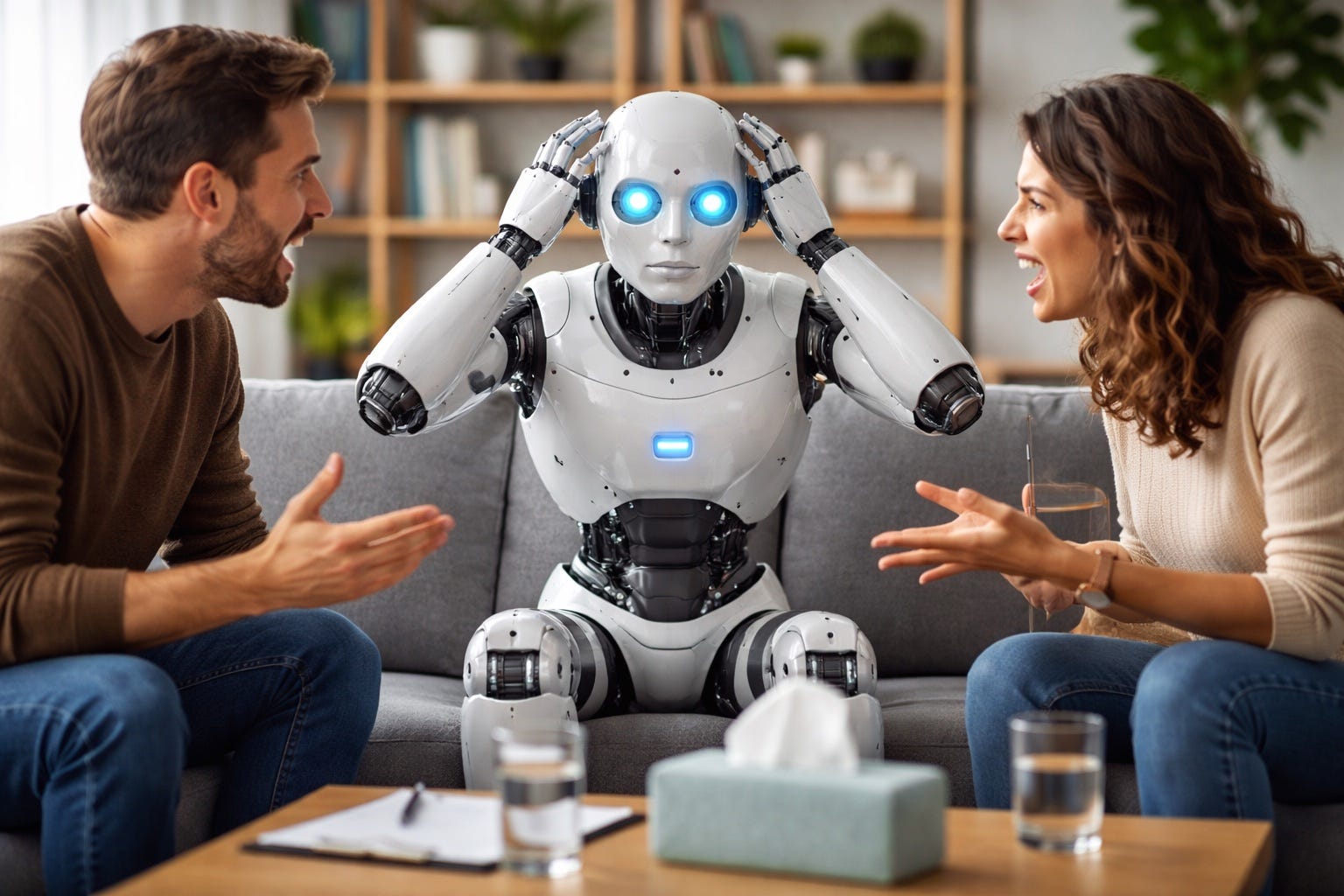
At present, however, human clinicians still move more competently inside complex relational storms. In marriage counseling, conflict can escalate in seconds. Accusations surface. Old injuries reappear. One partner floods emotionally while the other shuts down. A skilled therapist doesn’t simply calm each person. The therapist holds the tension between them and helps redirect the interaction while it’s still unfolding. Research on couples and group psychotherapy emphasizes the importance of managing escalating interpersonal dynamics in real time (Johnson, 2004; Yalom & Leszcz, 2005). There isn’t yet evidence that AI systems can reliably facilitate volatile, multi-person therapeutic exchanges at that level.
In group therapy, the complexity multiplies. Emotions move quickly across the room. Alliances form and fracture. Someone withdraws. Someone challenges. The facilitator has to read the entire room at once and decide when to intervene and when to remain steady. That kind of live, multi-person navigation is still handled more effectively by human clinicians right now.
Much of what we understand about therapeutic change rests on relational exchange. Emotional connection between humans isn’t only verbal but physiological. Supportive human presence can reduce threat responses in the brain and body (Coan, Schaefer, & Davidson, 2006). A machine can imitate warmth and timing. What we don’t yet know is whether interacting with a robot can create the same depth of change as sitting with another person.
The trajectory of development doesn’t stop at structured individual work. Major technology companies are investing heavily in robotics, affective computing, and emotionally adaptive AI. Research in affective computing focuses on enabling machines to detect facial cues, vocal tone shifts, and behavioral signals with increasing precision (Picard, 1997; McDuff & Czerwinski, 2018). Robotics firms are developing humanoid platforms designed for natural, socially responsive interaction.
If a humanoid robot can sit across from a client, track subtle emotional shifts, and respond with calibrated precision, what can a human offer that a machine cannot at that point? If measurable outcomes eventually converge, does the biological nature of the therapist still matter?
For now, human clinicians demonstrate greater flexibility in live relational complexity. Whether that distinction narrows over time is a question that can only be answered through careful research and real-world outcomes. We still don’t know whether a calculator that walks and talks like a human can be the equivalent of a real person in the counseling room. And we have yet to find out, whether we’re asking these questions too early — or too late.
References
Burlingame, G. M., McClendon, D. T., & Alonso, J. (2011). Cohesion in group therapy. Psychotherapy, 48(1), 34–42.
Coan, J. A., Schaefer, H. S., & Davidson, R. J. (2006). Lending a hand: Social regulation of the neural response to threat. Psychological Science, 17(12), 1032–1039.
Fitzpatrick, K. K., Darcy, A., & Vierhile, M. (2017). Delivering cognitive behavior therapy to young adults with symptoms of depression and anxiety using a fully automated conversational agent. JMIR Mental Health, 4(2), e19.
Johnson, S. M. (2004). The practice of emotionally focused couple therapy: Creating connection (2nd ed.). Brunner-Routledge.
Miner, A. S., Laranjo, L., & Kocaballi, A. B. (2019). Chatbots in the fight against the COVID-19 pandemic. NPJ Digital Medicine, 2, 65.
McDuff, D., & Czerwinski, M. (2018). Designing emotionally sentient agents. Communications of the ACM, 61(12), 74–83.
Picard, R. W. (1997). Affective computing. MIT Press.
Yalom, I. D., & Leszcz, M. (2005). The theory and practice of group psychotherapy (5th ed.). Basic Books.
The Storyboard Method for Counseling is organizational licensing. Training comes with the license.